 |
r8brain-free-src
High-quality pro audio sample rate converter library
|

|
|
r8brain-free-src
High-quality pro audio sample rate converter library
|
|
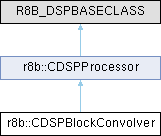
Single-block overlap-save convolution processing class. More...
#include <CDSPBlockConvolver.h>
Public Member Functions | |
| CDSPBlockConvolver (CDSPFIRFilter &aFilter, const int aUpFactor, const int aDownFactor, const double PrevLatency=0.0, const bool aDoConsumeLatency=true) | |
| Initializes internal variables and constants of this object. | |
| virtual void | clear () |
| Clears (resets) the state of this object and returns it to the state after construction. | |
| virtual int | getInLenBeforeOutPos (const int ReqOutPos) const |
| Returns the number of input samples required to advance to the specified output sample position (so that the next process() call passes this output position). | |
| virtual int | getLatency () const |
| Return the latency, in samples, which is present in the output signal. | |
| virtual double | getLatencyFrac () const |
| Returns fractional latency, in samples, which is present in the output signal. | |
| virtual int | getMaxOutLen (const int MaxInLen) const |
Returns the maximal length of the output buffer required when processing the MaxInLen number of input samples. | |
| virtual int | process (double *ip, int l0, double *&op0) |
| Performs DSP processing. | |
Single-block overlap-save convolution processing class.
Class that implements single-block overlap-save convolution processing. The length of a single FFT block used depends on the length of the filter kernel.
The rationale behind "single-block" processing is that increasing the FFT block length by 2 is more efficient than performing convolution at the same FFT block length but using two blocks.
This class also implements a built-in resampling by any whole-number factor, which simplifies the overall resampling objects topology.
| r8b::CDSPBlockConvolver::CDSPBlockConvolver | ( | CDSPFIRFilter & | aFilter, |
| const int | aUpFactor, | ||
| const int | aDownFactor, | ||
| const double | PrevLatency = 0.0, | ||
| const bool | aDoConsumeLatency = true ) |
Initializes internal variables and constants of this object.
| aFilter | Pre-calculated filter data. Reference to this object is inhertied by this object, and the object will be released when this object is destroyed. If upsampling is used, filter's gain should be equal to the upsampling factor. |
| aUpFactor | The upsampling factor, positive value. E.g., value of 2 means 2x upsampling should be performed over the input data. |
| aDownFactor | The downsampling factor, positive value. E.g., value of 2 means 2x downsampling should be performed over the output data. |
| PrevLatency | Latency, in samples (any value greater or equal to 0), which was left in the output signal by a previous process. This value is usually non-zero if the minimum-phase filters are in use. This value is always zero if the linear-phase filters are in use. |
| aDoConsumeLatency | true if the output latency should be consumed. Does not apply to the fractional part of the latency (if such part is available). |
|
virtual |
Clears (resets) the state of this object and returns it to the state after construction.
All input data accumulated in the internal buffer so far will be discarded.
Implements r8b::CDSPProcessor.
|
virtual |
Returns the number of input samples required to advance to the specified output sample position (so that the next process() call passes this output position).
Assumes starting at the cleared or after-construction state of this object.
Note that the implementation of this function assumes the caller only needs to estimate an initial buffering requirement; passing a full sample length value (e.g., greater than 100000) may overflow the calculation or cause rounding errors.
| ReqOutPos | The required output position. Set to 0 to obtain "input length before output start" latency. Must be a non-negative value. |
Implements r8b::CDSPProcessor.
|
virtual |
Return the latency, in samples, which is present in the output signal.
This value is usually zero if the DSP processor "consumes" the latency automatically.
Implements r8b::CDSPProcessor.
|
virtual |
Returns fractional latency, in samples, which is present in the output signal.
This value is usually zero if a linear-phase filtering is used. With minimum-phase filters in use, this value can be non-zero even if the getLatency() function returns zero.
Implements r8b::CDSPProcessor.
|
virtual |
Returns the maximal length of the output buffer required when processing the MaxInLen number of input samples.
| MaxInLen | The number of samples planned to process at once, at most. |
Implements r8b::CDSPProcessor.
|
virtual |
Performs DSP processing.
| ip | Input data pointer. | |
| l0 | How many samples to process. | |
| [out] | op0 | Output data pointer. The capacity of this buffer should be equal to the value returned by the getMaxOutLen() function for the given l0. This buffer can be equal to ip only if the getMaxOutLen( l0 ) call returned a value lesser than l0. This pointer can be incremented on function's return if latency compensation was performed by the processor. Note that on function's return, this pointer may point to some internal buffers, including the ip buffer, ignoring the originally passed value. |
op0 buffer and available after processing. This value can be smaller or larger in comparison to the original l0 value due to processing and filter's latency compensation that took place, and due to resampling if it was performed. Implements r8b::CDSPProcessor.
 1.13.2